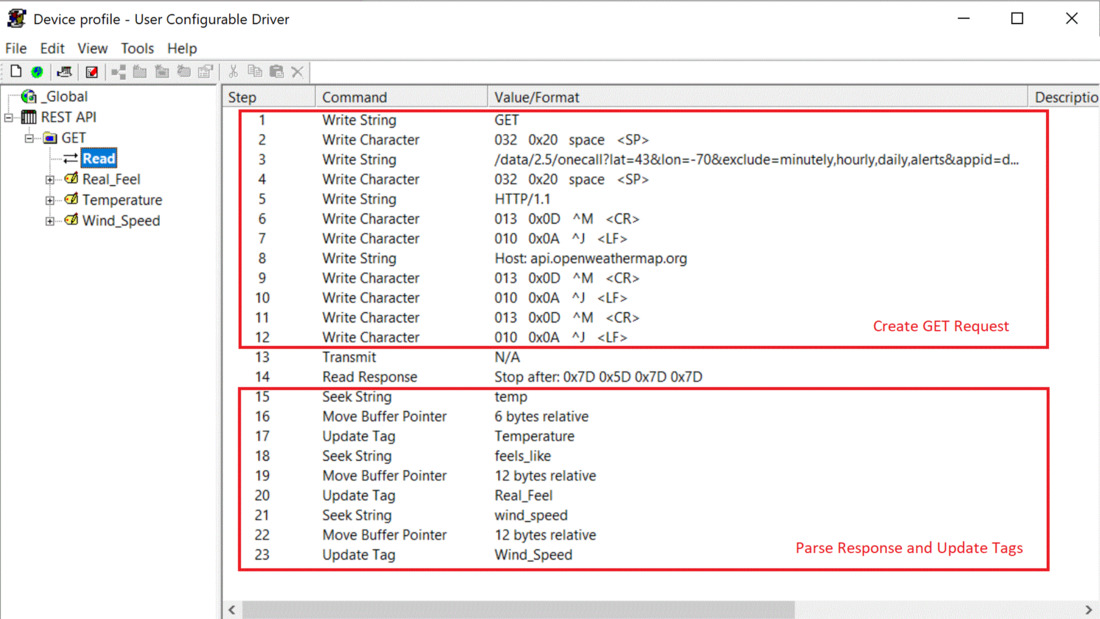
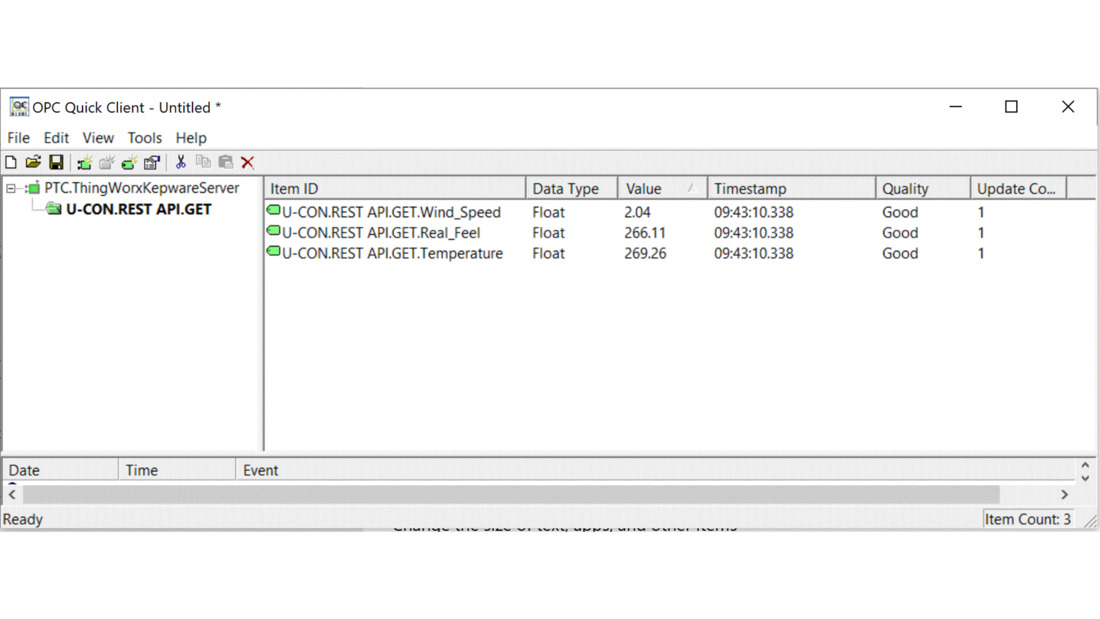
For the sake of the upcoming demonstration, we will be working with the Open Weather Map API located at api.openweathermap.org. This open API provides the ability to issue HTTP GET requests to read weather data for a given area. Here is an example of the HTTP endpoint being accessed by a web browser and the associated payload within the response.
http://api.openweathermap.org/data/2.5/onecall?lat=43.65&lon=70.25&exclude=hourly,daily,minutely&appid={Your app key}
Response:
{
"lat": 43.65,
"lon": -70.25,
"timezone": "America/New_York",
"timezone_offset": -14400,
"current": {
"dt": 1687889314,
"sunrise": 1687856474,
"sunset": 1687911995,
"temp": 294.15,
"feels_like": 294.66,
"pressure": 1009,
"humidity": 90,
"dew_point": 292.45,
"uvi": 1.35,
"clouds": 100,
"visibility": 10000,
"wind_speed": 5.14,
"wind_deg": 160,
"weather": [
{
"id": 804,
"main": "Clouds",
"description": "overcast clouds",
"icon": "04d"
}
]
}
}
Im Hintergrund wird, wie in den anderen Beispielen auch, eine HTTP GET-Anfrage vom Browser an die API gesendet. Sie können die Struktur der GET-Anfrage mithilfe von Netzwerküberwachungstools wie Wireshark ermitteln. Wireshark bietet eine Funktion, mit der Sie einem spezifischen TCP-Datenstrom folgen können. Mit anderen Worten können Sie alle Nachrichten einsehen, die innerhalb dieses TCP-Sockets gesendet werden. Beim Verfolgen des TCP-Datenstroms der Verbindung wird die GET-Anfrage wie folgt dargestellt:
GET /data/2.5/onecall?lat=43.65&lon=-70.25&exclude=hourly,daily,minutely&appid={my personalized app key} HTTP/1.1
Host: api.openweathermap.org
The HTTP response is as follows:
HTTP/1.1 200 OK
Server: openresty
Date: Tue, 27 Jun 2023 18:21:00 GMT
Content-Type: application/json; charset=utf-8
Content-Length: 393
Connection: keep-alive
X-Cache-Key: /data/2.5/onecall?exclude=hourly,daily,minutely&lat=43.65&lon=-70.25
Access-Control-Allow-Origin: *
Access-Control-Allow-Credentials: true
Access-Control-Allow-Methods: GET, POST
{"lat":43.65,"lon":-70.25,"timezone":"America/New_York","timezone_offset":-14400,"current":{"dt":1687890040,"sunrise":1687856474,"sunset":1687911995,"temp":294.21,"feels_like":294.72,"pressure":1009,"humidity":90,"dew_point":292.51,"uvi":1.35,"clouds":100,"visibility":10000,"wind_speed":5.14,"wind_deg":160,"weather":[{"id":804,"main":"Clouds","description":"overcast clouds","icon":"04d"}]}}
The goal within the Kepware custom driver is to rebuild this exact based HTTP request and to parse the associated response.