Industrial AI

Industrial AI is a leadership challenge far more than a technology challenge.

In The Journey to Value in Industrial AI, Velotic CEO Brian Shepherd offers a practical map for turning industrial AI into operational value. Explore the Industrial AI Value Cube, five prerequisites that shape progress, and lessons from five organizations already on the journey – then decide where to move next.

White paper
The Challenge

Industrial operations are different

Physical laws

AI approaches that work elsewhere in the enterprise do not automatically translate to the physical world of the plant. Industrial operations are full of machines, sensors, equipment, robots and people, with decisions governed by physics and the consequences of being wrong measured in scrap, downtime and safety.

Physical AI defined

There is a useful name for the kind of AI industrial operations needs: Physical AI. Physical AI perceives reality through sensors, reasons about processes governed by physics rather than language, and acts on machines under governance.

Beyond pilots

That means operations leaders need a fit-for-purpose AI strategy. The destination is compelling – faster answers, better predictions, better decisions and, where appropriate, action – but getting there takes more than a collection of pilots.

Why industrial AI is different

Hear from Brian Shepherd

Brian Shepherd explains why AI in the physical world requires a different approach – and why leadership, not simply model capability, determines whether organizations move from pilots to value.

Watch the video
Industrial AI
The Value Cube

Start with value

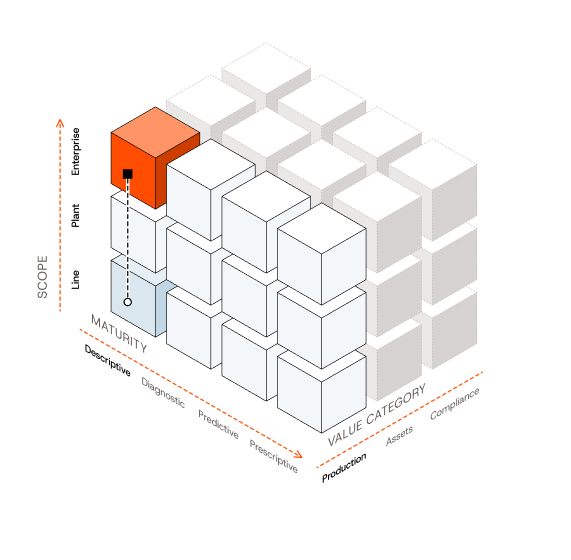
The Value Cube is a map rather than a prescribed route. There is no required sequence and no mandatory first stop. It maps three independent directions of travel: value category, maturity and scope of implementation.

Value category

Where can AI iprove the fundemental value drivers of operations? 

  • Production
  • Assets
  • Compliance
Maturity

What do you want from your data – status, insight, predictions or recommendations?

  • Descriptive
  • Diagnostic
  • Predictive
  • Prescriptive
Scope

Where does the capability operate, and where should it expand next?

  • Line / cell
  • Plant
  • Enterprise

Which direction is worth moving next?

Value grows by moving along any one axis and can compound across them. A use case proven on one line, matured from describing to prescribing, and then carried to every plant does not simply add value – it multiplies it.

Weigh each opportunity against value, readiness, economics, risk, and repeatability. Define the result you want, who owns it, and how you will measure improvement from today’s baseline. Consider what it will cost to implement and maintain, what safeguards it needs, and how much the next plant can reuse.

placeholder

Explore industrial AI: Papa Johns and Velotic

Join Papa Johns’ Eric Clark and Velotic CEO Brian Shepherd on December 16 for a fireside chat on industrial AI. Explore lessons on data, people, and scaling value, discover the Industrial AI Value Cube, and ask your questions live.

Register now
The Prerequisites

Five things to get right

Moving along the axes of the Value Cube depends on five prerequisites – resources or decisions that define how fast you can move and how far you can go. These are not merely technical or IT decisions. They have strong business implications. The lowest answer to the five resource questions, not the highest, sets the pace at which everything else can move.

Set the pace

The right tool for the job

GenAI and LLMs can provide tremendous benefits in operations, but they are one part of a broader toolbox that also includes constraint-based optimisation, computer vision, spatial computing, predictive models and other mathematical approaches. Language models are a useful interface to Physical AI. They are not a substitute for it.

A real industrial data foundation

Data is the precursor to intelligence. AI needs trustworthy, contextualised operational data – connected across machines, sensors and systems such as MES, maintenance, quality, PLM and ERP. Context cannot simply be recovered on the fly by a model.

AI in the right place and at the right cost

The deployment architecture must balance cost, performance, security and resilience. Real-time decisions may require the edge; other use cases need plant-level context or enterprise-scale reasoning. For most organisations, the answer will be a blend of on-premise and cloud capabilities.

Trustworthy by design

Trust is a property of how an industrial AI system is built. It must be grounded, contextual, explainable, governed and bounded. The authority to act should be explicitly granted and reflect the consequence of being wrong.

Autonomous or augmented

Industrial operations also depends on authentic intelligence – the experience and know-how held by operators, technicians and engineers. The leadership decision is how to blend artificial and authentic intelligence, use case by use case, across augmented and autonomous operations.

Where does your Industrial AI journey stand?

The five prerequisites determine how fast and how far an organisation can move. Velotic can help you assess the foundations already in place, identify the gaps that may constrain progress and determine which direction in the Value Cube is worth moving next.

Talk to our team
From Pilot to Scale

A pilot proves feasibility. It rarely changes the P&L

Most companies start with a pilot, and they should. The leadership challenge is the second plant and all of the plants after that. Scaling introduces data rationalisation, programme management, organisational change and architecture decisions that a single pilot can hide.

Every use case built without a shared foundation rebuilds the same infrastructure underneath it: connectivity, context, governance, monitoring and deployment. The first pilot absorbs that cost invisibly. Subsequent deployments incur it again and again.

The question worth asking at the outset is therefore not only what the first use case costs. It is what the subsequent ones cost – and how much of the foundation each new use case can inherit rather than rebuild.

Put what operations know to work

Velotic brings together Proficy, Kepware and ThingWorx – proven industrial software capabilities spanning connectivity, trusted operational history, context, analytics, applications and execution.

Working together as an Industrial Intelligence System, the Velotic portfolio provides an Industrial Intelligence Loop: abstracting machine signals, aggregating them as trusted history, adding context to enrich the data, applying analytics to supply insight and understanding, executing work through governed agents and trusted workflows, and learning from every outcome.

Industrial AI increases the intelligence moving through that loop

Velotic is designed for real industrial environments – heterogeneous equipment and systems, on-premise and cloud deployment, open standards and interfaces, and a model-agnostic approach to AI. The goal is not AI for its own sake. It is better-performing operations that stay dependable as they evolve and conditions change.

  • Access & abstract
  • Aggregate
  • Contextualize & visualize
  • Analyze & decide
  • Execute
  • Compare & learn
Proof

Case studies

[Velotic team to align on case studies to display below]

Explore

Resources

[Velotic team to align on resources to display below]

FAQs

Frequently asked questions

What is industrial AI?

Industrial AI applies artificial intelligence and related analytical approaches to industrial operations, where data comes from machines, sensors, processes and operational systems and where recommendations or actions can affect the physical world. It includes language-based and mathematical approaches; the objective is to use the right tool for the operational task.


What is Physical AI?

Physical AI perceives reality through sensors, reasons about processes governed by physics rather than language, and acts on machines under governance. Language models can be a useful interface to Physical AI, but they are not a substitute for the broader system.


Where should industrial organizations start with AI?

Start with the operational value you want to create. Use the Value Cube to consider value category, maturity and scope, then assess whether the five prerequisites are strong enough to support the move.


What is the Value Cube?

The Value Cube is a 3D map to value across three independent axes: value category – production, assets and compliance; maturity – descriptive, diagnostic, predictive and prescriptive; and scope – line or cell, plant and enterprise.


What needs to be right before industrial AI can scale?

Five areas shape how fast and how far an organization can move: the right tool for the job, a real industrial data foundation, AI in the right place and at the right cost, trustworthy-by-design architecture, and the right blend of autonomous and augmented operations. The weakest of the five sets the pace.


Why is industrial data context important for AI?

AI needs trustworthy, contextualized data to analyze or reason over. A sensor value becomes useful when connected to units, time, location, operating conditions, history and relevant information from other systems. Without that foundation, even a capable model has nothing coherent to reason over.


What does trustworthy industrial AI mean?

Trustworthy industrial AI is grounded, contextual, explainable, governed and bounded. Permissions, data access, model use and authority to act should be explicit, traceable and appropriate to the consequence of being wrong.


What is the difference between augmented and autonomous operations?

Augmented operations use AI to give people better insight, recommendations and guided workflows. Autonomous operations give AI bounded authority to act where confidence is high and the path to action is well understood. Both matter; the mix is a leadership decision made use case by use case.


What is authentic intelligence?

Authentic intelligence is the operational knowledge and experience held by people – the know-how operators, technicians and engineers use to recognize what good looks, sounds and feels like. Industrial AI should work with and extend that expertise.


What is the Industrial Intelligence Loop?

The Industrial Intelligence Loop describes how machine signals are abstracted, aggregated as trusted history, enriched with context, analyzed for insight and understanding, carried into governed execution, and used to learn from every outcome. Industrial AI increases the intelligence moving through that loop.


Does adopting industrial AI require replacing existing systems?

Not necessarily. Industrial environments are heterogeneous. Velotic’s approach is open by design, supporting diverse equipment, industrial standards and interfaces, cloud and on-premise environments, and a model-agnostic AI strategy while protecting existing investments.


How do you move industrial AI beyond pilots?

A pilot proves feasibility. Scaling requires repeatable foundations for connectivity, context, governance, monitoring and deployment, plus the organizational change needed to carry successful capabilities across lines, plants and teams.
Assess. Plan. Move.

Assess where you are. Decide where to move next.

Assess your readiness against the five prerequisites, map your current positions in the Value Cube, and prioritize your next moves. Build a practical plan with clear outcomes, owners, costs, and safeguards – then move forward one step at a time.

Talk to our team

Connect with our experts to assess your current capabilities, identify opportunities, and plan your next steps with industrial AI.

Read the white paper

Explore the Value Cube, five prerequisites, and customer lessons to help plan your next move.