Battery manufacturing software
Increase efficiency, throughput, and traceability across the battery manufacturing process.
 Get battery manufacturing kit
Overcome production limitations and meet increased customer demands
Is your battery manufacturing process inefficient with limited capabilities to scale? Are you struggling to meet the traceability requirements for all battery manufacturing?
Powered by analytics
Battery manufacturing is a complicated process to be sure. At Velotic, we get the battery manufacturing process and have been supporting manufacturers for decades. From precision batch mixing and computational track & trace to large data analytics, we’ve been partnering with companies like yours to design and implement systems that get results.
Deliver on traceability
Battery manufacturers are struggling to keep up with demand while maintaining quality and safety. GE Vernova can help you unlock the hidden capacity in your factories, empower your workforce, reduce variability and increase plant efficiency. Modern cloud and edge technologies are now available to boost MES capabilities and help ensure compliance with regulations and deliver end-to-end traceability and uncompromising quality. Some of our use cases for improving traceability include: - Digitized work instructions and SOPs - Quality hold: non-conformance, rework and quarantine - Alarm management, corrective action and exception management - QA plan and sampling - Troubleshooting trees - Production set up
Battery manufacturing process solve
Velotic software can help reduce process variation and optimize performance – Throughput, Yield, Recovery, Quality, Waste, Energy (W.A.G.E.S), Emissions, and Downtime. You can digitize your operations and apply analytics to real-time and historical data to optimize process settings.
Kepware
Connect machines, robots, PLCs, conveyors, quality systems, and enterprise applications to create a trusted industrial data foundation across battery manufacturing operations.
ThingWorx
Create a connected battery manufacturing enterprise with real-time visibility into production performance, asset utilization, quality metrics, and operational KPIs across plants and supply chains.
Proficy Smart Factory MES
Improve production execution, quality management, genealogy, traceability, and scale production capacity.
Proficy CSense
Leverage advanced analytics and AI-driven insights to reduce process variability, improve first-time quality, optimize throughput, and predict production issues before they impact operations.
Explore battery manufacturing digital transformation resources
Explore expert perspectives, customer success stories, and best practices covering industrial connectivity, operational intelligence, industrial AI, and digital transformation for battery manufacturing.
View moreAll Resources
-
Pirelli Manages High Data Volumes With Proficy MES and iFIX
Learn how Pirelli manages high data volumes with Proficy MES and iFIX software, via a real-time view of production that ensures quality across all processes.
Case study -
Volvo Car Engine Achieves Zero Downtime With Proficy MES Software
Learn how Volvo Car Engine achieved zero downtime and zero quality problems by using GE Vernova's Proficy Manufacturing Execution Systems (MES) Software.
Case study -
Modernizing Automotive Assembly: Why Upgrading Legacy MES is a Business Imperative
In this session, you’ll learn how leading automotive manufacturers are: Reducing risk by moving away from legacy MES Enabling real-time, data-driven operations Lowering total cost of ownership with modern, automotive-focused solutions Migrating with minimal disruption to production
Video -
ANCAP Transforms Operations and Improves Efficiency with iFIX from Velotic
Learn how ANCAP transforms operations and enhances efficiency with iFIX from Velotic.
Case study -
Kepware’s IoT Gateway Provides Faurecia with Data to Improve Traceability for Top Automotive Customers
Faurecia is recognized as a pioneer in technological innovations - reducing the weight of vehicles, offering customized comfort and style solutions, and mitigating any impact on the environment.
Case study -
Brüggen Improves Workflow and Optimizes Production Processes
See how Brüggen improves workflow and production processes with Proficy software from Velotic.
Case study -
Major Automotive Manufacturer Improves Efficiency and Quality With Proficy Software
Learn how a major automotive OEM realized a reduction in time and effort for inspection activities using Velotic's CIMPLICITY HMI/SCADA software.
Case study -
Niobec Revitalizes Mine with 95% Autonomous Data Management
See how Niobec revitalizes mine with 95% autonomous data management with Proficy software.
Case study -
Perodua Reduce WIP Inventory With Proficy Software
Read how Velotic gave Perodua, Malaysia's second largest car manufacturer, a real-time window into manufacturing production status with Proficy software.
Case study -
SAGW Reduces Inspection Costs by 40% using Proficy Plant Applications and Process Digital Twins
Learn how SAGW transformed manufacturing processes and slashed inspection costs by 40% by leveraging Velotic's Proficy Plant Applications and Process Digital Twins.
Case study
Blog
-
Introducing Kepware Edge and Kepware Server
Learn more about Kepware’s Fall 2025 Release, including Kepware for Linux and a unified platform for Windows.
Blog -
Kepware Recognized as Outright Leader in Edge Connectivity by QKS
Get a free copy of the report and learn why Kepware is still the outright leader in connectivity.
Blog -
Automotive Manufacturers: Smart Digital Transformation Yields Five Powerful Outcomes
Read how digital transformation of auto manufacturing can create new value through increased productivity, greater agility & greater customer satisfaction.
Blog -
The Benefit of Automated Storage/Retrieval Systems (AS/RS) in Manufacturing
Learn how AS/RS can help improve capacity in your manufacturing facility, decrease errors in selecting materials, and increase throughput with greater efficiency.
Blog -
ThingWorx and Leela AI Team Up to Improve Production Performance Using Vision AI
Learn how this collaboration of Velotic ThingWorx and Leela AI boosts efficiency and performance to revolutionize production with Vision AI.
Blog -
Putting Lean to Work: Enhancing Software Installs through Kaizen
Learn how implementing lean kaizen principles can improve software installation processes, driving efficiency and continuous improvement in your organization.
Blog -
What is Digital Transformation in Automotive Manufacturing?
Explore the role of digital transformation in automotive manufacturing, driving innovation, efficiency, and competitiveness in a rapidly evolving industry.
Blog -
Benefits of Utilities Analytics & Automation Software for Energy Savings and Efficiency
Learn how real-time utilities software analytics enable engineers & operators to continuously benchmark and improve utilities consumption at plants and facilities.
Blog -
Maximize Value Throughout Your Digital Transformation Journey
Learn how to drive value at every stage of your digital journey by implementing effective strategies and leveraging innovative technologies.
Blog -
How Automotive Manufacturers Leverage Industrial Software to Speed Innovation
Discover how automotive manufacturers leverage digital industrial applications to accelerate innovation, revolutionizing expertise on the factory floor.
Blog
Case study
-
Pirelli Manages High Data Volumes With Proficy MES and iFIX
Learn how Pirelli manages high data volumes with Proficy MES and iFIX software, via a real-time view of production that ensures quality across all processes.
Case study -
Volvo Car Engine Achieves Zero Downtime With Proficy MES Software
Learn how Volvo Car Engine achieved zero downtime and zero quality problems by using GE Vernova's Proficy Manufacturing Execution Systems (MES) Software.
Case study -
ANCAP Transforms Operations and Improves Efficiency with iFIX from Velotic
Learn how ANCAP transforms operations and enhances efficiency with iFIX from Velotic.
Case study -
Kepware’s IoT Gateway Provides Faurecia with Data to Improve Traceability for Top Automotive Customers
Faurecia is recognized as a pioneer in technological innovations - reducing the weight of vehicles, offering customized comfort and style solutions, and mitigating any impact on the environment.
Case study -
Brüggen Improves Workflow and Optimizes Production Processes
See how Brüggen improves workflow and production processes with Proficy software from Velotic.
Case study -
Major Automotive Manufacturer Improves Efficiency and Quality With Proficy Software
Learn how a major automotive OEM realized a reduction in time and effort for inspection activities using Velotic's CIMPLICITY HMI/SCADA software.
Case study -
Niobec Revitalizes Mine with 95% Autonomous Data Management
See how Niobec revitalizes mine with 95% autonomous data management with Proficy software.
Case study -
Perodua Reduce WIP Inventory With Proficy Software
Read how Velotic gave Perodua, Malaysia's second largest car manufacturer, a real-time window into manufacturing production status with Proficy software.
Case study -
SAGW Reduces Inspection Costs by 40% using Proficy Plant Applications and Process Digital Twins
Learn how SAGW transformed manufacturing processes and slashed inspection costs by 40% by leveraging Velotic's Proficy Plant Applications and Process Digital Twins.
Case study -
Shanghai Automotive Industry Corporation (SAIC) and GM Improve Uptime & Productivity With Velotic Proficy
Learn how Velotic's Proficy MES team integrated a comprehensive production monitoring and control system for SAIC-GM.
Case study
Video
-
Modernizing Automotive Assembly: Why Upgrading Legacy MES is a Business Imperative
In this session, you’ll learn how leading automotive manufacturers are: Reducing risk by moving away from legacy MES Enabling real-time, data-driven operations Lowering total cost of ownership with modern, automotive-focused solutions Migrating with minimal disruption to production
Video
Frequently asked questions
What is battery manufacturing?
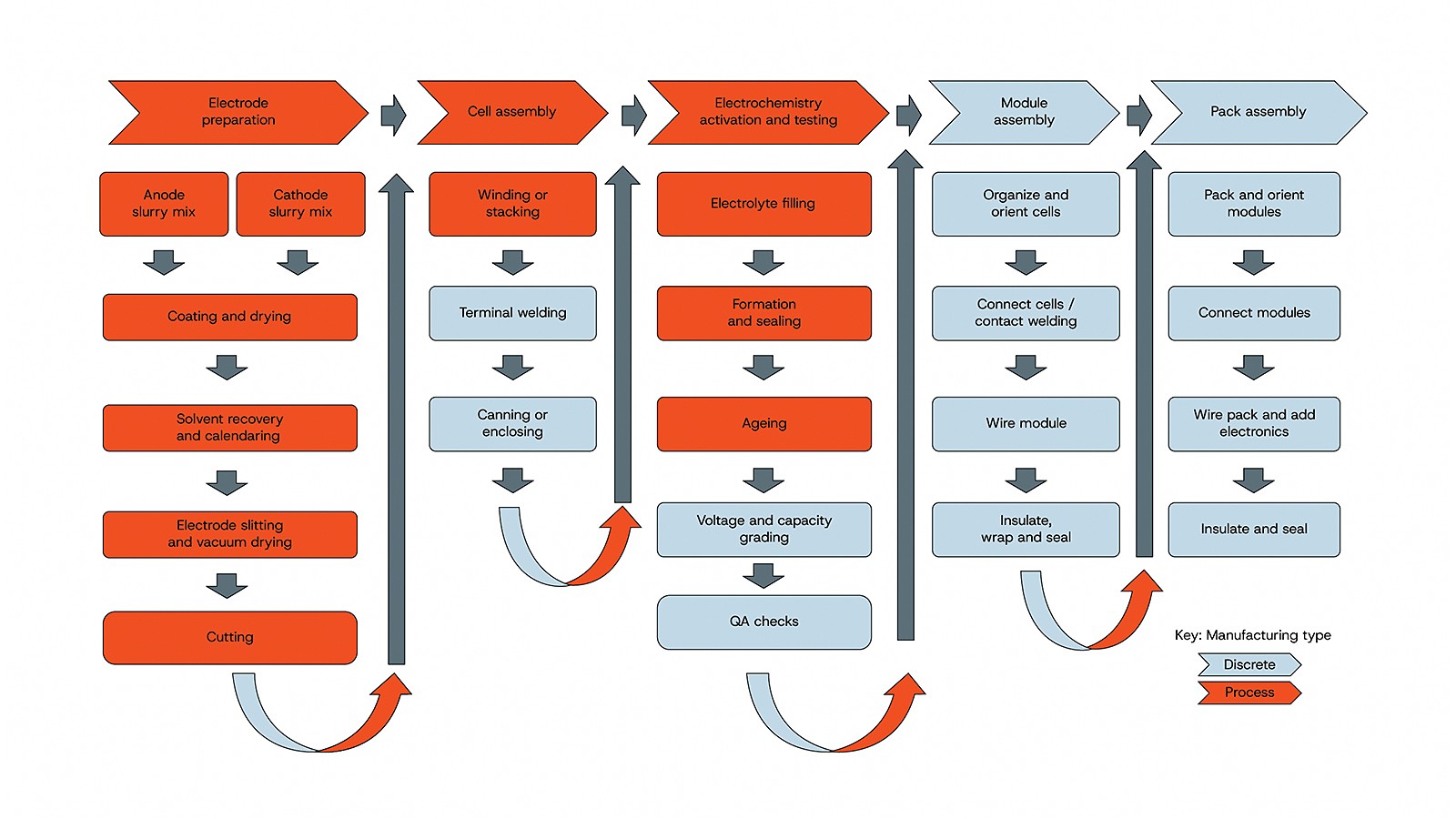
Battery manufacturing is the process of producing energy storage devices that power electric vehicles (EVs), consumer electronics, and renewable energy systems. It involves several stages, including electrode production, cell assembly, electrolyte filling, formation and aging, and final testing. Each step must meet strict regulatory quality, safety, and performance standards. In EV battery manufacturing, lithium-ion technology is most common due to its high energy density and long cycle life. The process requires advanced materials, precision engineering, and increasingly, digital technologies like AI, IoT, and automation to optimize efficiency, traceability, and sustainability. As demand for EVs grows, battery manufacturing is becoming a critical pillar of the global clean energy transition.
What are the key stages in battery manufacturing?
Battery manufacturing involves several precise and interdependent stages to ensure high performance, safety, and consistency. The key stages include:
- Electrode Manufacturing: Mixing active materials, coating them onto metal foils, and drying to form anodes and cathodes.
- Cell Assembly: Cutting, stacking or winding electrodes with separators, and enclosing them in a casing.
- Electrolyte Filling: Injecting electrolyte into the sealed cell to enable ion transport.
- Formation and Aging: Charging and discharging cells under controlled conditions to activate materials and stabilize performance.
- Testing and Grading: Evaluating electrical and safety characteristics to sort cells by quality.
- Module and Pack Assembly: Grouping cells into modules and packs with thermal management and battery management systems (BMS).
What are battery manufacturing software solutions?
Battery manufacturing software solutions are digital tools designed to optimize, automate, and manage the complex processes involved in producing batteries—especially lithium-ion batteries for electric vehicles. These solutions integrate data from across the production line, including materials handling, cell assembly, formation, testing, and quality control. Key features often include work order scheduling, execution & real-time monitoring, shopfloor material management, maintenance management, traceability production reporting, and analytics including AI. By leveraging these tools, manufacturers can improve yield, reduce downtime, ensure compliance with safety standards, and accelerate innovation. These software platforms are essential for scaling production efficiently while maintaining high quality and sustainability in a rapidly evolving energy storage industry.
What are the benefits of battery manufacturing software?
Battery manufacturing software such as Proficy Smart Factory MES offers significant benefits that can drive operational excellence and innovation. Proficy Smart Factory MES can enhance productivity by automating workflows and providing real-time visibility into production processes. Quality can improve by leveraging advanced analytics and traceability, which help detect and prevent defects early. Predictive maintenance reduces unplanned downtime, while digital twin technology accelerates process optimization and time-to-market. These solutions also support regulatory compliance (or the “battery passport”) by maintaining detailed records and can ensure consistent standards. Cost efficiency can be achieved through optimized resource use and reduced waste. Additionally, Proficy Smart Factory MES is scalable, allowing manufacturers to adapt quickly to growing demand and integrate new technologies. Overall, it can empower manufacturers to produce high-quality batteries more efficiently and sustainably.
Why is specialized software necessary for battery manufacturing?
Specialized software is essential for battery manufacturing due to the complexity, precision, and scale required in producing high-performance batteries—especially for electric vehicles. Unlike general manufacturing, battery production involves tightly controlled chemical processes, multi-stage assembly, and rigorous quality standards. Specialized software enables real-time monitoring, data integration, and predictive analytics tailored to battery-specific workflows, such as electrode coating, cell formation, and aging. It ensures traceability across every component and process, which is critical for safety, compliance, and performance validation. Additionally, it supports rapid innovation through simulation and digital twin technologies. Without specialized tools, manufacturers risk inefficiencies, quality issues, and slower response to market demands in this fast-evolving industry.
Who are battery manufacturing solutions designed for?
Battery manufacturing software solutions are designed for a wide range of stakeholders across the battery production ecosystem. These include operations managers, who need real-time visibility and control over supply chains and production lines; quality assurance teams, who rely on data-driven tools to ensure product consistency and compliance; and maintenance engineers, who use predictive analytics to minimize downtime. Process engineers benefit from optimization tools and digital twins to improve efficiency, while executives and plant managers use dashboards and reports to make strategic decisions. Additionally, IT and digital transformation leaders use these solutions to integrate systems and scale operations. Ultimately, these tools empower every level of the organization to produce safer, higher-quality batteries more efficiently.
How does this software improve battery cell quality and yield?
Battery manufacturing software such as Manufacturing Execution Systems (MES) plays a critical role in improving battery cell quality and yield by providing real-time visibility, control, and traceability across the production process. MES ensures that every step, from electrode coating to cell formation, is executed consistently and within defined parameters preventing non-conformances and waste. It captures detailed process and quality data, enabling early detection of deviations and root cause analysis. By enforcing standardized workflows and integrating with quality control systems, MES reduces variability and defects. It also supports predictive maintenance & quality, minimizing downtime and ensuring equipment reliability. With advanced analytics and reporting, MES helps manufacturers continuously optimize processes, leading to higher yields, better product consistency, and reduced scrap and rework.
What battery manufacturing processes does Velotic software support?
Velotic software can help reduce process variation and optimize performance – Throughput, Yield, Recovery, Quality, Waste, Energy (W.A.G.E.S), Emissions, and Downtime. You can digitize your operations and apply analytics to real-time and historical data to optimize process settings.
Proficy Smart Factory MES software supports the diverse battery production process in one manufacturing platform, decreasing your OT costs and maintenance, and giving you a foundation for operations optimization.
Velotic software can enable you to:
• Battery Manufacturing Solve:
Achieve faster time to market & on time deliveries while increasing compliance and improving quality consistency (First Time Right) and increasing production throughput.
• Efficiency Management:
Track downtime and waste while managing OEE and root causes. Get standard and ad-hoc reports & dashboards.
• Production Management:
Track downtime and waste while managing OEE and root causes. Get standard and ad-hoc reports & dashboards.
• Quality Management:
Get real-time product & process quality analysis & control along with alarms to conformance limits. Lower your waste, scrap & recall costs and deliver Right First-Time consistency.
• Batch Analysis:
Batch analysis & reporting according to ISA-88 through electronic batch records while adding to both new and existing systems. Gain analysis of scheduled and completed batches.
• Battery Manufacturing Enterprise Solve:
Solve complex problems that require enterprise-wide data aggregation while connecting workers & processes. Connect enterprise visibility across factories through contextualized and normalized data to achieve best practice sharing.
How does Proficy Smart Factory MES software improve battery cell quality and yield?
Proficy Smart Factory MES (Manufacturing Execution System) software can significantly enhance battery cell quality and yield by providing real-time control, visibility, and traceability across the production process. It can ensure that each step—from electrode coating to cell formation—is executed within strict parameters, reducing variability and defects. Proficy Smart Factory MES captures detailed process and quality data, utilizing Machine Learning AI to enable early detection of anomalies and root cause analysis. It can enforce standardized workflows and integrate with quality control systems to maintain consistency. By supporting predictive maintenance and minimizing downtime, Proficy Smart Factory MES also helps maintain optimal production conditions. These capabilities collectively can lead to higher first-pass yield, reduced scrap and rework, and more reliable, high-performance battery cells.
How does MES software support regulatory compliance?
Proficy Smart Factory MES (Manufacturing Execution System) software supports regulatory compliance by providing complete traceability, standardized workflows, and automated documentation throughout the battery manufacturing process. It captures and stores detailed data on materials, equipment, process parameters, and operator actions in real time, creating a digital record for every cell produced. This ensures compliance with industry standards such as ISO, IATF 16949, battery passports, and environmental and safety regulations. MES also enforces quality checks and process validations at critical control points, reducing the risk of non-conformance. During audits, manufacturers can quickly retrieve historical data and reports, demonstrating adherence to regulatory requirements and improving transparency and accountability across the production lifecycle.
Can battery manufacturing software integrate with our existing plant floor equipment and ERP systems?
Yes, battery manufacturing software like MES (Manufacturing Execution Systems) is specifically designed to integrate seamlessly with existing plant floor equipment and enterprise systems such as ERP. MES acts as a digital bridge between operational technology (OT) and information technology (IT), enabling real-time data exchange across machines, sensors, PLCs, SCADA systems, and higher-level business platforms. This integration ensures synchronized production planning, inventory management, quality control, and maintenance workflows. By connecting with ERP systems, MES helps align shop floor activities with business objectives, improving traceability, resource utilization, and decision-making. Most modern MES platforms support open standards and APIs, making them adaptable to diverse manufacturing environments and legacy systems.
Integrating a Manufacturing Execution System (MES) with an Enterprise Resource Planning (ERP) system creates a unified digital ecosystem that enhances visibility, coordination, and efficiency across the entire battery manufacturing operation.
Key benefits include:
- Real-Time Data Synchronization: Aligns production activities with business planning for accurate scheduling and inventory control.
- Improved Traceability: Links shop floor data with enterprise records for end-to-end product genealogy and compliance.
- Enhanced Decision-Making: Combines operational and financial insights for more informed strategic planning. Reduced Manual Effort: Automates data entry and reporting, minimizing errors and administrative overhead.
- Faster Response to Issues: Enables quicker adjustments to production plans based on real-time shop floor feedback.
- Optimized Resource Utilization: Improves coordination of materials, labor, and equipment across departments.
How does battery manufacturing software help scale production from a pilot line to a Gigafactory?
Battery manufacturing software, such as MES and advanced analytics platforms, plays a crucial role in scaling production from a pilot line to a full-scale Gigafactory. It standardizes processes, ensuring that best practices developed during pilot runs are consistently applied across expanded operations. The software enables real-time monitoring, quality control, and traceability, which are essential for maintaining performance and safety at scale. It also supports modular expansion by integrating new lines, equipment, and systems without disrupting existing workflows. With predictive maintenance, digital twins, and data-driven optimization, manufacturers can increase throughput, reduce downtime, and adapt quickly to changing demand—making large-scale, high-quality battery production both efficient and sustainable.