Proficy Tracker | Velotic

Proficy Tracker

Discover how Proficy Tracker enables real-time production tracking, material flow control, and traceability to improve manufacturing operations.
Placeholder image Talk to an expert
Overview

Increase production performance

Track and manage production flow in real time to reduce delays, control WIP, improve sequencing, increase throughput, and keep orders moving efficiently through manufacturing.

Maximize asset performance

Coordinate production flow with available equipment and resources to reduce bottlenecks, avoid unnecessary waiting, and keep assets productive as conditions change on the plant floor.

Improve compliance, quality & resilience

Capture genealogy and traceability while managing holds, defects, substitutions, and exceptions to contain quality issues, support audits, reduce recall exposure, and build right the first time.

Accelerate transformation & innovation

Digitize production tracking, routing, and order execution to replace manual processes with real-time visibility and control that enable more agile, connected, and responsive operations.
Placeholder image
Get Started

How to get started

Watch the demo

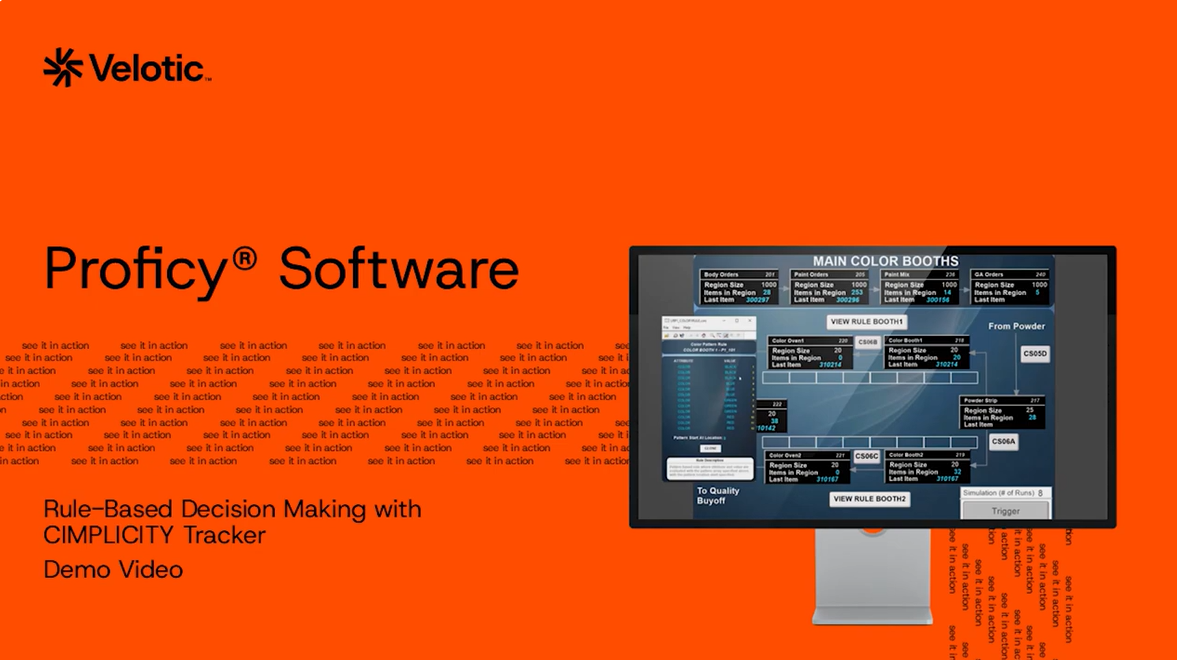
See how Proficy Tracker manages production orders, routing, sequencing, and WIP to keep complex manufacturing operations moving efficiently.

Explore the latest release

See the latest enhancements to help manufacturers streamline the tracking, routing, and sequencing of discrete part manufacturing processes

Find a partner

Explore potential partners to help kickstart your Proficy Tracker journey.

Core Capabilities

Core capabilities

Real-time production tracking

Track serialized items, materials, components, carriers, and production orders as they move through manufacturing. Real-time location and status visibility helps teams monitor WIP, identify delays, and keep production moving.
Placeholder image

Dynamic routing & order execution

Automate routing decisions based on production requirements and real-time plant conditions. Direct jobs, materials, and components through the correct operations to improve flow, reduce errors, and support efficient order execution.

Placeholder image

Production sequencing & flow control

Manage complex production sequences and coordinate the movement of components through lines and assembly processes. Respond to changing conditions while maintaining the correct production flow and meeting schedule requirements.
Placeholder image

WIP & inventory control

Gain real-time visibility into work-in-process inventory, location, status, and movement. Better control of WIP helps manufacturers reduce excess inventory, avoid shortages, improve material flow, and support Lean manufacturing.

Genealogy & traceability

Capture detailed genealogy and traceability as products move through production. Maintain a digital history of materials, components, routes, and production events to support investigations, audits, compliance, and recalls.

Quality & defect containment

Manage defects, holds, substitutions, and production exceptions in real time. Prevent affected products from moving forward, contain quality issues earlier, and help reduce scrap, rework, warranty costs, and recall exposure.

Rule-based production decisions

Apply configurable rules to automate routing, blocking, sequencing, and other production decisions. Adapt execution logic to real-world plant conditions while maintaining greater control and consistency across operations.

Scalable production control

Coordinate complex production and assembly processes across equipment, lines, and facilities with scalable, standards-based technology designed to support connected manufacturing and enterprise-wide operations.

Velotic Portfolio

See how our products work together

Velotic portfolio options

Proficy Tracker + Proficy CIMPLICITY

Proficy CIMPLICITY provides the real-time HMI/SCADA foundation for Tracker, connecting production equipment and control systems with the visualization and control needed to track, route, and manage work as it moves through manufacturing.

Connect production with real-time control

Connect Tracker with machines, conveyors, PLCs, and automation systems through CIMPLICITY to bring real-time equipment and production conditions into routing, sequencing, and order execution decisions.

Visualize production flow

Give operators real-time visibility into the location, status, and movement of jobs and materials through intuitive HMI/SCADA screens, helping teams quickly identify disruptions and keep production moving.

Respond dynamically to change

Use real-time plant conditions and configurable production rules to adapt routing and execution as disruptions occur, helping operators manage exceptions while maintaining efficient production flow.

Learn more

Proficy Tracker + Proficy Smart Factory MES

Proficy Smart Factory MES extends production tracking with broader manufacturing execution, performance, quality, and production management capabilities to provide a more complete view of how manufacturing operations are performing.

Connect tracking with execution

Combine real-time routing and WIP tracking with work orders, materials, production processes, quality, labor, and other MES context to create a more complete digital view of manufacturing execution.

Improve production performance

Connect production flow with OEE, downtime, throughput, quality, and loss information to understand how routing and execution affect performance and identify opportunities to increase capacity and productivity.

Strengthen manufacturing traceability

Combine detailed tracking and genealogy with MES production and quality records to investigate issues faster, improve product history, strengthen compliance, and reduce warranty and recall exposure.

Learn more

Proficy Tracker + Proficy Scheduler

Proficy Scheduler connects optimized production planning with Tracker's real-time order execution, helping manufacturers translate achievable schedules into efficient shop-floor flow while responding quickly when conditions change.

Create executable production schedules

Build realistic schedules based on capacity, materials, labor, equipment, and other manufacturing constraints to establish an achievable production plan before orders reach the shop floor.

Connect planning with execution

Align scheduled production with real-time routing, sequencing, and order execution so planned priorities can translate into coordinated movement of jobs and materials through manufacturing.

Adapt to production changes

Use real-time execution information to understand the impact of downtime, delays, shortages, and changing priorities, helping planners adjust schedules and keep production aligned with current shop-floor conditions.

Learn more

Proficy Tracker + Proficy Operations Hub

Proficy Operations Hub extends Tracker data into centralized, web-based operational experiences, helping users visualize production flow, WIP, order status, and other manufacturing information across roles and operations.

Visualize production status

Bring order, routing, WIP, and production status into intuitive web-based dashboards that help operators and leaders understand where jobs are, how production is progressing, and where attention is needed.

Connect production data in context

Combine Tracker information with MES, Historian, HMI/SCADA, and other industrial data to create a broader view of production flow, equipment conditions, performance, and manufacturing operations.

Build role-based operational views

Create web-based applications tailored to operators, supervisors, engineers, and leaders so each user can access the production information, KPIs, and workflows most relevant to their responsibilities.

Learn more
Resources

Resources

View more
Case Studies

Case studies

View more
FAQs

Frequently asked questions

What is production tracking software?

Production tracking software is a digital tool used to monitor, manage, and optimize the progress of manufacturing processes. It provides visibility into the status of work orders, material flow, and production events—enabling better coordination, improved productivity, and reduced delays throughout the production line. At a more detailed level, production tracking software captures up-to-date information from equipment sensors, operator inputs, and control systems to monitor where each job is in the process and whether it's progressing as expected. It often includes routing logic to guide parts or products through the correct sequence of operations and supports tracking of work-in-progress (WIP), hold statuses, substitutions, and broadcast instructions to downstream stations. This detailed visibility helps ensure efficient flow, supports production accuracy, and enables teams to respond more quickly to emerging issues.

How do you track the production process?

Tracking the production process involves collecting status data from each stage of the operation—often by connecting to production equipment or using operator input. This data reflects where an order is, what step it’s in, and whether it’s on schedule. By digitally capturing this information, manufacturers can coordinate more effectively, minimize delays, and make informed decisions on the shop floor.

How does production tracking software work?

Production tracking software uses data from machines and operator stations to monitor the flow of shop orders through each step of the manufacturing process. As materials move through equipment, the system records progress and status updates—linking them to specific orders, resources, and workflows. This enables automated order sequencing, inventory management, and process enforcement without manual tracking or paper-based systems.

How can production tracking software improve manufacturing efficiency?

With continuous visibility into the movement and progress of orders, production tracking software helps identify issues before they cause delays—such as bottlenecks, idle machines, or inventory shortages. Early insights into deviations or slowdowns allow teams to intervene quickly, minimize downtime, improve resource allocation, and keep production on track.

What industries benefit the most from using production tracking software?

Production tracking software supports operations across a wide range of industries—including automotive, aerospace, electronics, industrial equipment, consumer goods, and more. Any organization that needs to improve order visibility, ensure process accuracy, or reduce cycle time can benefit from this technology—regardless of whether they operate in discrete, process, or mixed-mode manufacturing.

What features should you look for in production tracking software?

Important features include order and routing status tracking, equipment-based data collection, performance analytics, resource and inventory monitoring, quality tracking, and automated reporting. Look for systems that allow configuration of routing rules, track substitutions or holds, and integrate easily with MES, SCADA, or ERP systems to support end-to-end production visibility. You should consider the following features in production tracking software: Data collection and visualization: Production tracking software gathers data from various sources on the shop floor, providing a centralized view of production status. Production scheduling and planning: These systems help manufacturers optimize production schedules, considering factors like resource availability, lead times, and order priorities. Work-in-progress (WIP) tracking: WIP tracking enables manufacturers to monitor the progress of sales and production orders in real-time, providing a virtual window into shop floor operations. Quality control and defect tracking: Many systems offer features for tracking and addressing quality issues, including defect tracking and temperature sensors. Overall Equipment Effectiveness (OEE) tracking: OEE tracking provides a comprehensive view of machine performance, availability, and quality, helping identify areas for improvement. Manufacturing dashboards and analytics: These systems often include customizable dashboards that provide real-time insights into production performance, allowing manufacturers to make informed decisions.

How does production tracking software help monitor real-time production data?

Production tracking software continuously collects and updates production information by connecting directly to equipment and control systems on the shop floor. This automated data capture ensures that order status, material movement, and process steps are consistently reflected in the system as they occur. Because the data is updated frequently and with minimal delay, teams gain timely visibility into current production activity—enabling faster response to issues and more informed decision-making without relying on error-prone manual inputs.

What are the benefits of using production tracking software for small and large-scale operations?

For smaller manufacturers, production tracking software improves visibility into order progress, which helps increase reliability and on-time delivery. With clearer insights into what's happening on the shop floor, teams can reduce reliance on buffer inventory, identify potential delays earlier, and operate with greater confidence—without adding administrative overhead. For large-scale operations, production tracking software enables coordinated execution across multiple lines, work cells, or departments. It supports centralized monitoring, streamlined scheduling, and consistent order traceability—making it easier to manage complexity at scale. The result is greater alignment across teams, fewer bottlenecks, and more efficient use of people, equipment, and materials. The main benefits of ssing Production Tracking Software are: Improved efficiency: Real-time data and visibility allow manufacturers to optimize processes and reduce waste. Better decision-making: Data-driven insights enable informed decisions about production planning, scheduling, and quality control. Increased productivity: By identifying bottlenecks and streamlining workflows, production tracking software can help improve overall productivity. Reduced costs: Improved efficiency and reduced waste can lead to significant cost savings. Enhanced quality: Real-time defect tracking and quality control features can help ensure consistent product quality.

What is the difference between production tracking software and ERP systems?

ERP systems are designed for planning and managing enterprise resources, such as inventory, procurement, and finance. Production tracking software, by contrast, operates closer to the shop floor—monitoring actual production activity, tracking work order status, and enforcing routing rules. ERP systems often receive data from production tracking tools to maintain an accurate picture of production progress.

How does production tracking software integrate with other tools like MES, SCADA, or IoT platforms?

Production tracking is often a core component of MES and is designed to streamline integration with SCADA systems, IoT sensors, and ERP software. These integrations enable a unified view of operations—from sensor-level activity to enterprise-wide reporting—and allow manufacturers to coordinate workflows, share production data, and automate decisions across systems. Technically, integration is typically achieved through a combination of standard protocols and APIs. SCADA systems may transmit equipment signals via OPC UA or MQTT, while IoT devices stream data through edge gateways or cloud brokers. Production tracking software consumes this data, often using middleware or MES connectors to translate raw inputs into meaningful status updates. ERP systems are integrated at the transactional level—for example, receiving order completions or production quantities—via RESTful APIs, web services, or message queues. This layered integration ensures data flows securely and consistently between systems, enabling accurate planning, execution, and reporting.

How can production tracking software help identify bottlenecks in the production process?

By continuously capturing equipment and order status data, production tracking software can reveal areas where delays occur most often—such as machines with extended changeover times or steps where WIP accumulates. With this insight, teams can analyze root causes, rebalance workflows, and target improvements that eliminate constraints and increase throughput.

How can production tracking software support scalability and multi-site operations?

Many modern production tracking software tools can be deployed across multiple lines, departments, or locations using standardized templates and shared infrastructure. This supports consistent process execution while enabling local flexibility. Centralized dashboards, cross-site reporting, and rule-based routing help organizations manage growth while maintaining performance and quality standards.

What are the challenges of implementing production tracking software, and how can they be overcome?

Challenges may include connecting legacy equipment to the network, ensuring the quality and consistency of collected data, and accurately modeling production workflows within the system. These obstacles can be addressed by using automation-friendly hardware, validating data sources during setup, and involving both operations and IT teams in the planning and implementation process. Working closely with an experienced software vendor can also make a significant difference. Vendors can offer best practices, proven implementation strategies, and technical support to help configure the system for your specific environment. Starting with a well-defined pilot and gradually scaling the solution allows teams to test assumptions, build internal confidence, and reduce complexity while laying a strong foundation for long-term success.