- MES (Manufacturing Execution Systems) and ERP (Enterprise Resource Planning) serve different but complementary roles in manufacturing operations. ERP manages enterprise-wide business processes such as finance, procurement, inventory, and supply chain, while MES focuses on executing and optimizing production on the shop floor.
- ERP systems plan and coordinate resources across the organization, helping companies manage orders, financials, human resources, and supply chain activities from a centralized platform.
- MES systems manage real-time production execution, collecting data from machines, sensors, and operators to monitor manufacturing performance, enforce workflows, and maintain quality and traceability.
- MES bridges the gap between enterprise planning and shop floor operations. It translates ERP production plans into actionable tasks on the plant floor while sending production data, material consumption, and order status back to the ERP system.
- MES provides granular, real-time operational insights, enabling manufacturers to track work orders, manage resources, ensure process compliance, and continuously optimize production performance.
- ERP delivers a holistic view of business performance, integrating data across departments to support strategic planning, reporting, and decision-making.
- Integrating MES and ERP creates a connected digital manufacturing ecosystem, aligning business planning with real-time production execution and improving visibility, efficiency, and decision-making across the enterprise.
- MES and ERP are not interchangeable technologies. Instead, they work together within the manufacturing technology stack—ERP handling enterprise-level planning while MES manages the execution and optimization of production processes.
SCADA, MES, & ERP Pyramid
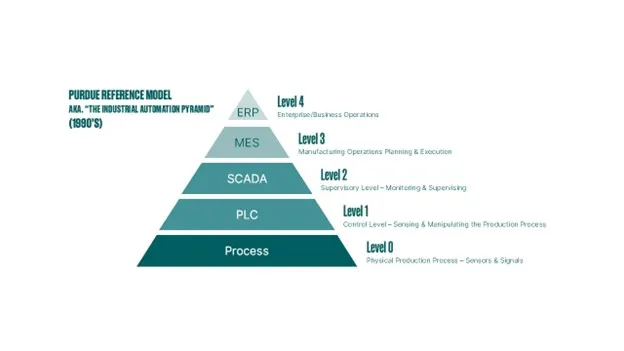
ERP handles the financial, resource and business elements of the organization. MES handles the production, optimization and traceability of the manufacturing process. SCADA is a real time interface to the production equipment providing monitoring, shop floor decision making and operator control. In conclusion, the two systems have different capabilities and are not interchangeable!
Continue reading
Blog
-
Velotic looks to the future: AI enters the heart of SCADA, historian, and the digital factory
Novotek Italy explores how Velotic's AI could transform SCADA, historian, and industrial software through intelligent alarms, AI agents, and more.
Blog -
Hyperscalability isn't about storing more data. It's about making industrial data accessible, contextualized, and AI-ready across the enterprise.
Blog -
Rethinking MES deployment: cloud vs on-prem cost, risk & TCO explained
Blog -
Introducing Velotic: Pioneering the Future of Industrial Software (from GE Vernova Proficy, PTC ThingWorx and Kepware)
Velotic is a new independent industrial software company formed from the combination of Proficy from GE Vernova and ThingWorx and Kepware from PTC.
Blog -
Unlocking Strategic Potential in Food & Beverage and CPG: Redeploying IT Resources After the Cloud Transition
Unlocking Strategic Potential in Food & Beverage and CPG: Redeploying IT Resources After the Cloud Transition
Blog -
Trusted MES Tools for Full Traceability and Genealogy in Regulated Manufacturing
Learn how MES tools support full traceability and genealogy with forward and backward lineage, batch records, audit trails, recall support, and compliance readiness.
Blog -
Close the Gap Between Insights and Action
Blog -
ThingWorx Supports CESMII Smart Manufacturing Interoperability
See how Velotic's CESMII integration building blocks for ThingWorx simplify interoperability, accelerate multi-site scale, and reduce custom integration work.
Blog -
Connected Worker Manufacturing: why connected workers don't need more data—they need context
Discover why successful Connected Worker manufacturing strategies focus on operational context—not just data—and how Proficy helps improve productivity, quality, safety, and workforce performance.
Blog -
Hyperscalability Isn’t About Storing More Data. It’s About Making Industrial Data Accessible, Contextualized, and AI-Ready Across the Enterprise.
Hyperscalability in manufacturing is no longer about storing more data. It’s about making industrial data accessible, contextualized, and AI-ready across the enterprise. Learn how modern historian platforms enable this shift.
Blog