Two trends are driving a focus on aligning quality, safety, and sustainability in food and beverage manufacturing.
- Global economic conditions are shifting consumer preferences towards budget products, making brand value, safety, and quality crucial to customer retention.
- Stakeholders including customers, employees, legislators, and investors are demanding manufacturers prioritize sustainability.
Fortunately, food and beverage manufacturers have a green light opportunity to lead by using existing quality and safety practices to set and achieve transformative environmental, social, and governance (ESG) goals! Digital solutions used for transparency, quality, and safety management are primed to help capture data, measure key performance indicators (KPIs), enable enterprise-wide reporting, provide insights with analytics, and optimize production for sustainability.
How can good manufacturing practices (GMPs) and existing food safety and quality management systems contribute to sustainability success?
According to Harvard Business Review, 79% of food companies in the UK struggle to measure and report on environmental performance. Manually tracking and tracing sustainability KPIs present major challenges. The report goes on to say that "digital technologies can significantly streamline this process." Automation systems to power GMPs that manage compliance for quality and safety have been widely adopted. For instance, by implementing Proficy Smart Factory, a major dairy manufacturer was able to connect to quality control systems across its enterprise, integrate for a modern Manufacturing Execution System (MES), and launch a digital transformation journey. Similar systems can also help tackle sustainability regulation.
Regulatory bodies encourage the use of software to reduce compliance timelines and meet safety guidelines.
Digital transformation for compliance is not new, in fact, the United States Food and Drug Administration (FDA) recently issued new draft guidance for quality management software as well as the Food Safety Modernization Act (FSMA) with a 2028 deadline for compliance. As an extension of their food safety standards, the European Union plans to adopt a legislative framework for sustainable food systems, including labelling requirements. Velotic's Digital solutions are aligned with these global changes by helping to optimize compliance while driving production efficiency and reducing variable industrial costs. Now, we are bridging these capabilities so manufacturers can link their environmental sustainability agendas to concrete plant-floor action logs. These foundations help enable enterprise agility to evolve as global sustainability compliance and labelling transparency requirements materialize and become international standards.
How are food and beverage manufacturers using digital transformation to tackle sustainable development goals (SDGs)?
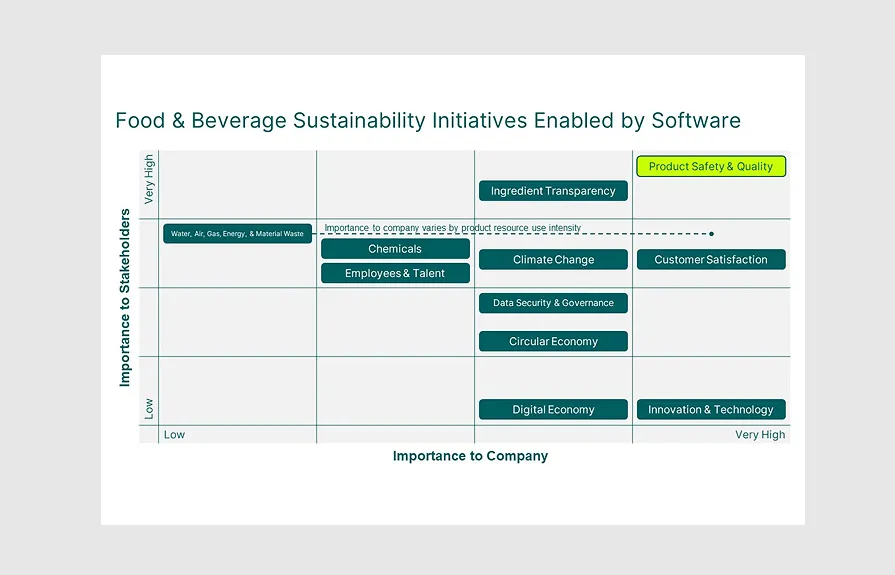
This visual reflects interpretation of various existing food & beverage company materiality matrix graphics. Importance rankings are dependent on each individual company’s resource use, strategy, and stakeholders' preferences.
Food and beverage manufacturers face increasing expectations to disclose climate-related risks, carbon emissions from operations, and demonstrate action toward a low-carbon future.
Leading companies are using software solutions to make progress in various areas:
- Safety & Quality, Ingredient Transparency, Customer Satisfaction: Reliable tracking and tracing of ingredients, quality inspections, and batch issue isolation.
- Climate Change: Help collect data on direct energy consumption in order to calculate GHG emissions from operations (Scope 1 and 2).
- Data Security & Governance: Automation of work and data flows, consistent and accurate data collection, trigger and track actions, and standards-based secure-by-design solutions.
- Chemicals: Track & trace features coupled with analytics help reduce production variance and optimize chemical usage without compromising quality.
- Employees & Talent: Occupational health, safety, and learning features, user-friendly interfaces, incident prevention alarms, and a customer portal for community assistance and training.
- Water, Air, Gas, Energy, & Material Waste: Lean software practices help identify waste and promote efficient resource utilization. Persona-based workflows help direct eco-efficiency actions to individual parts, lines, at one facility, or across sites.
- Circular Economy: Process management helps reduce resource use, data packages help associate material, batch, part, & quality inspection information to product barcodes, and automate clean capture of waste material for reuse at the plant or remarketing (selling for second use).
- Innovation & Technology: As a recognized manufacturing software Leader, Digital solutions offer configurable interfaces and no-code app development to accelerate innovation.
- Digital Economy: Enterprise-wide data availability, intelligence, and smart environments.
Process management principles such as Hazard Analysis Critical Control Points (HACCP system) can help operationalize sustainability goals.
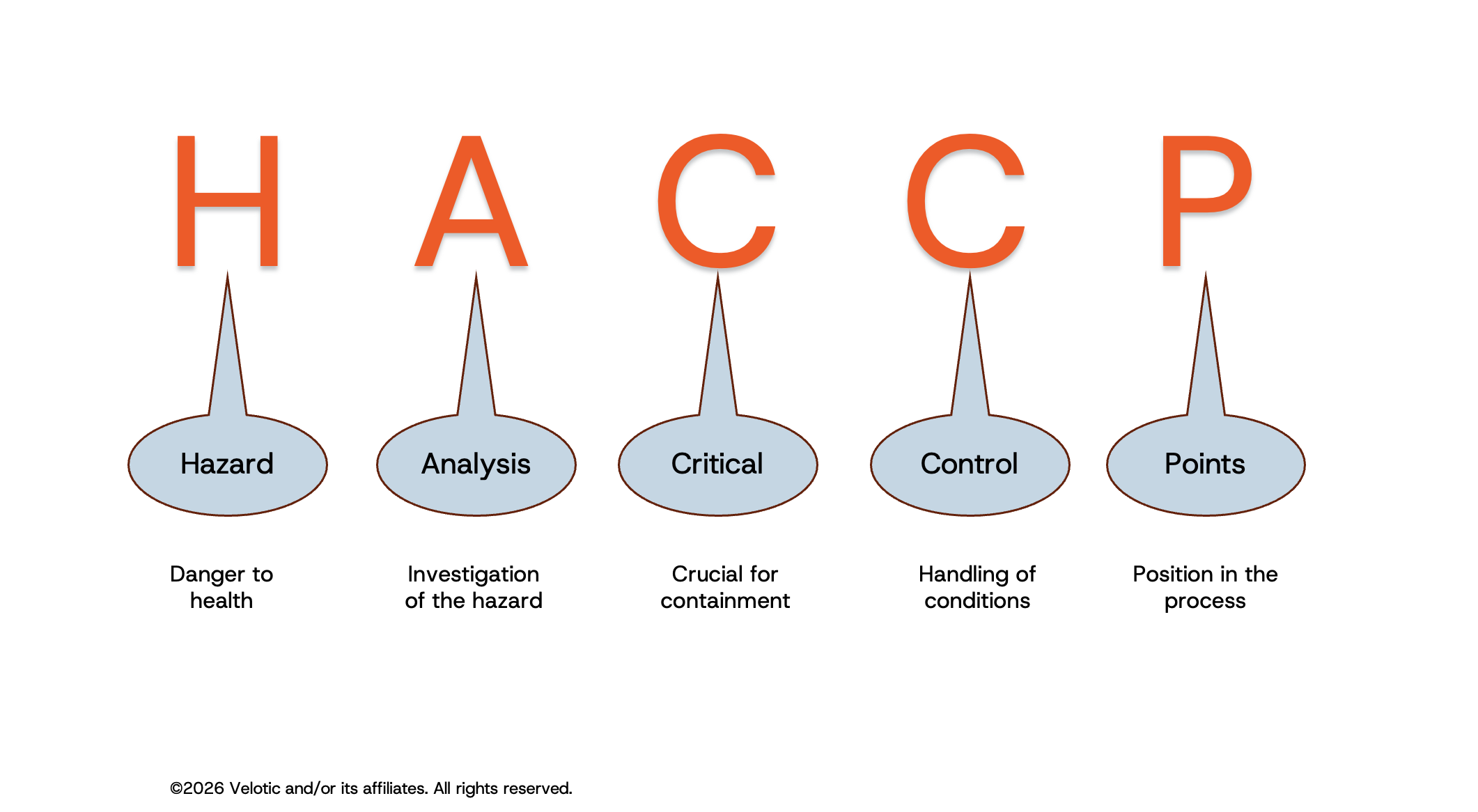
Under the HACCP methodology, food manufacturers are advised to develop a plan to:
- Conduct a hazard analysis
- Determine critical control points (CCPs)
- Establish critical limits
- Establish monitoring procedures
- Establish corrective actions
- Establish verification procedures
- Establish record-keeping and documentation procedures
To prepare for the future of food manufacturing, manufacturers can be inspired by HACCP standards or other codes such as Safe Quality Foods (SQF) and use digital tools to help understand, report on, and improve sustainability KPIs. Current sustainability reporting is characterized by annual, spreadsheet-based, and hand-assembled aggregations of operations data. Digitized, granular data is essential for food manufacturers to operationalize their energy transition and decarbonization strategies - and move from ambition to action.
How are digital sustainability management solutions evolving for the future of food manufacturing?
Velotic is continuously innovating the Proficy industrial software suite to ease adoption of sustainability best practices. In collaboration with customer innovation partners, our team is exploring real-time monitoring of utilities consumption, how to understand and explain usage rates relative to targets, and how enterprises can minimize both the costs and environmental impact of the electricity, water, and other inputs consumed to make products. Proficy software concepts may also help enterprises mine previously untapped data for sustainability business intelligence, enabling performance comparisons, best practice standardization, and network optimization.
By utilizing dependable, trusted Velotic software products, businesses can strive towards sustainability goals while capturing and creating business value.
Velotic solutions help enable food manufacturers to meet shareholder expectations, enhance brand image, mitigate greenwashing risk, reduce variable industrial costs, and build operational excellence.
Continue reading
Blog
-
Unlocking Strategic Potential in Food & Beverage and CPG: Redeploying IT Resources After the Cloud Transition
Unlocking Strategic Potential in Food & Beverage and CPG: Redeploying IT Resources After the Cloud Transition
Blog -
What is a Manufacturing Execution System (MES)?
Manufacturing Execution Systems (MES) ensure manufacturing operations are working to maximum efficiency. Read more to understand what MES is and how it works.
Blog -
Achieving Sustainable and Efficient Manufacturing with Proficy's sustainability insights capabilities
Proficy's sustainability insights capabilities helps manufacturers boost sustainability & efficiency. Optimize consumption, cut costs, & meet CSRD compliance. Learn how.
Blog -
Introducing Kepware Edge and Kepware Server
Learn more about Kepware’s Fall 2025 Release, including Kepware for Linux and a unified platform for Windows.
Blog -
Kepware Recognized as Outright Leader in Edge Connectivity by QKS
Get a free copy of the report and learn why Kepware is still the outright leader in connectivity.
Blog -
Breaking data silos: Smarter resource management across manufacturing systems
Break down data silos in manufacturing with Proficy for sustainability insights. Get timely data to make smarter, faster decisions that drive results.
Blog -
How to utilize resource optimization software for manufacturing sustainability
This blog outlines how to bridge the action-ambition gap in manufacturing with Proficy for sustainability insights to cut emissions, & boost results.
Blog -
The ROI of sustainability in manufacturing: Turning risk into profitability
Read this blog to learn how Proficy for sustainability insights helps manufacturing organizations optimize resources, reduce costs, and gain a competitive edge.
Blog -
The Benefits of Paperless Manufacturing on Production Data
Discover the benefits of paperless manufacturing in streamlining production data management, improving accuracy, and enhancing traceability across operations.
Blog -
ThingWorx and Leela AI Team Up to Improve Production Performance Using Vision AI
Learn how this collaboration of Velotic ThingWorx and Leela AI boosts efficiency and performance to revolutionize production with Vision AI.
Blog